The Brilliant Gray of Stow Wengenroth
June 15, 2026. Last Saturday, I traveled to Greenport, NY, where lithographer Stow Wengenroth lived for more than twenty years with his first wife, Edith Flack Ackley.
I live in the town - Rockport, MA - where Wengenroth lived for four years with his second wife, Harriet Matson, and where he passed away. Over the course of his career, Wengenroth immortalized corners and coves, birds and boats, in both towns. Both wives and both towns were dear to him.
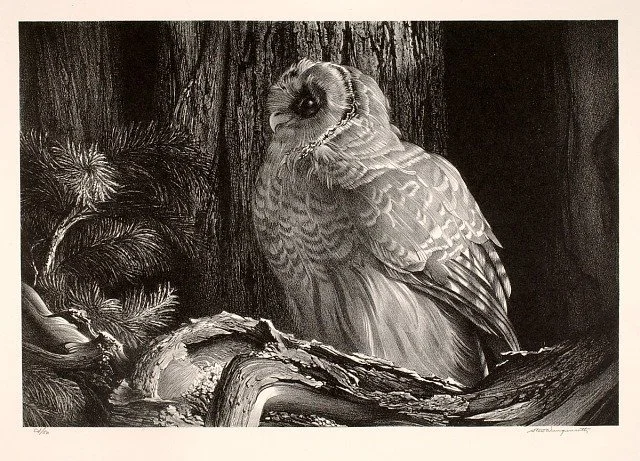
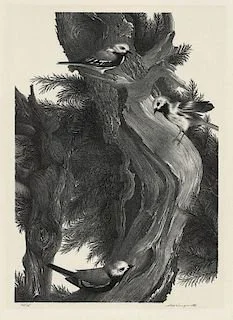
When I look at a Stow Wengenroth work, I don’t say, “oh, there’s that Rockport quarry - ” Rather, when I walk around Rockport I think, there is that Stow. There are his pine needles, his bark, his shingles, his breaking waves, his beached dory, his light.
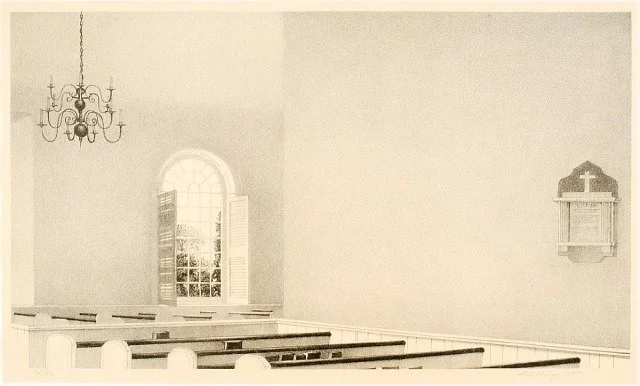
Stow captured much more than iconic scenes; he captured the imprint of the thing on his eye, and told us therefore more than we could have ever known about a chickadee, an owl, a meetinghouse interior.
Albert Reese, a 20th century print expert, said this about Wengenroth: “The sea, the pine forest, the lighthouses, the dunes, there are no surprises in his choice of subject, only the surprise of his achievement. Technique can accomplish much, love even more. And it’s love that Stow brings to his subject, a love of nature in all its myriad aspects, a love that can extract the beauty of a roadside flower no less than that of a tidal flat or rocky cove.”
The Boston Public Library held a comprehensive exhibit of Wengenroth prints in 1961. Many compared this work to Hopper and Wyeth, but Boston Globe art critic Robert Taylor said that the Wengenroth work “is minus the vastness and loneliness of those artists; instead it is overtly concerned with eternity in a grain of sand.”
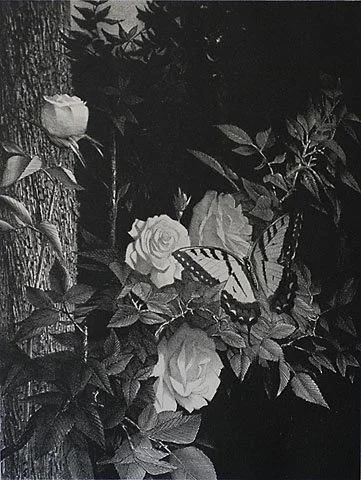
Wengenroth’s acuity transcends the “realist” description. By all accounts he was a cheerful, hardworking fellow - (you can see and hear him talking about his process in my Color of Light video here) - but many of his finest lithographs communicate a higher message that for lack of a better word say “grace.”
Arthur Heinzelman, former Director of Prints for the Boston Public Library (and also a Rockport resident) said of Wengenroth’s late lithographs, “one cannot place this work in other schools; Wengenroth was not concerned with the genre to which they belonged.”
In the Floyd Memorial Library in Greenport, the exhibit I traveled to see included a presentation of materials by Wengenroth’s first wife, Edith Flack Ackley, and her sister, children’s book author Marjorie Flack.
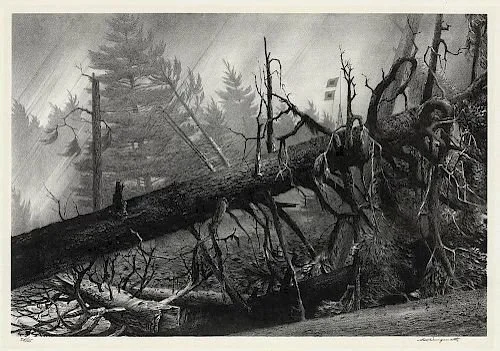
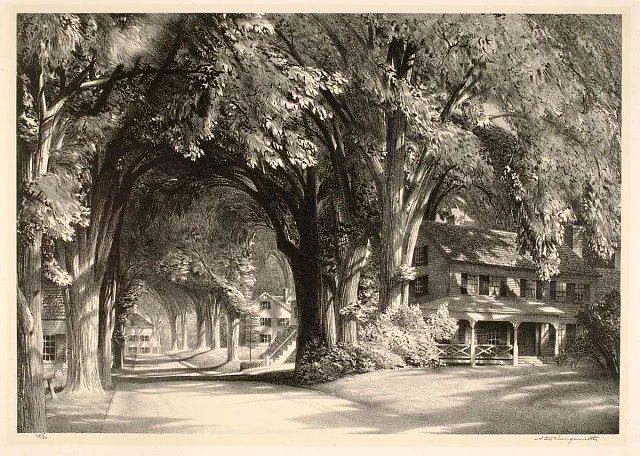
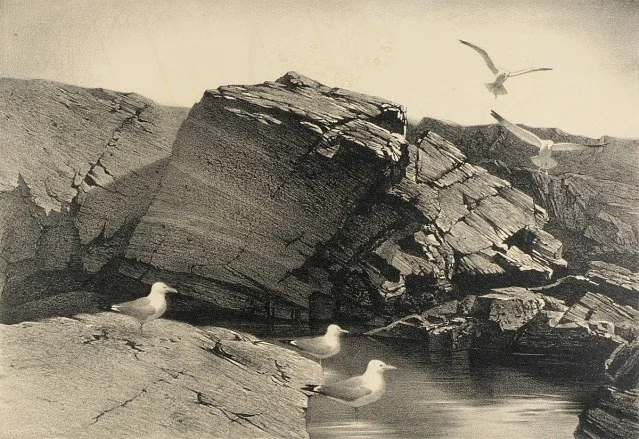
But the weight of the exhibit was about twenty drawings done by Wengenroth in his early 20’s, before he ever made a lithograph. Many were drawings from a youthful first trip to France. These works have the mark of an art student interpreting foreign views for the first time, tackling a range of complex compositions: Parisian bridges, cathedral interiors, and building facades. But these youthful drawings made me understand even better why a mature Wengenroth is so beautiful: Wengenroth is the master of tonal range. There are maybe a hundred variations of gray between the ebony black and the white of the page in a Wengenroth lithograph. There is something wizard-like about his ability to charm “gray.”
That range is absent in these very early drawings, which is fine. He was still an art student then, and just understanding drawing. But when Wengenroth made his first lithographs, at the behest of the Macbeth Gallery owner, who looked at drawings like these and said, “I will show these if you make lithographs out of them,” Wengenroth never turned back. The 80-pound stones became his truest life partner, allowing him to describe in black and white what his eyes and soul found in the world.
Mary Arbuckle’s video “pitch” to PBS in 1978.
In a rare interview with Stow Wengenroth filmed by Mary Arbuckle, Wengenroth points out a section of a print about which he is particularly proud. It is the section of a leafed tree against a brick facade. In the film he runs his hand - a particularly long hand, elongated palm and long fingers - quickly but softly over that section of sparkling, lacey grays. He does it a number of times, as if he is touching the memory of what the drawing felt like on stone. In that same film, we see Wengenroth running water over a lithograph stone, and then that hand so gently moves across the stone, pushing the excess water away. This is a love affair.
The medium made this artist. Stow Wengenroth drew well, but ink and stone made him genius.
List of works above:
Hurricane, Port Cylde, Maine, printed in December, 1955
Midsummer Shade, Wiscasset, Maine, printed in February 1953
Tide Pool, Ogunquit, Maine, printed in December 1962
Barred Owl, Greenport, NY, printed in February 1962
Warbler, Greenport, NY, printed in February, 1961
Church Interior, New Castle, Delaware, printed in June 1962
Memory, Greenport, NY, printed in February, 1971