Ralph Coburn, shy pioneer
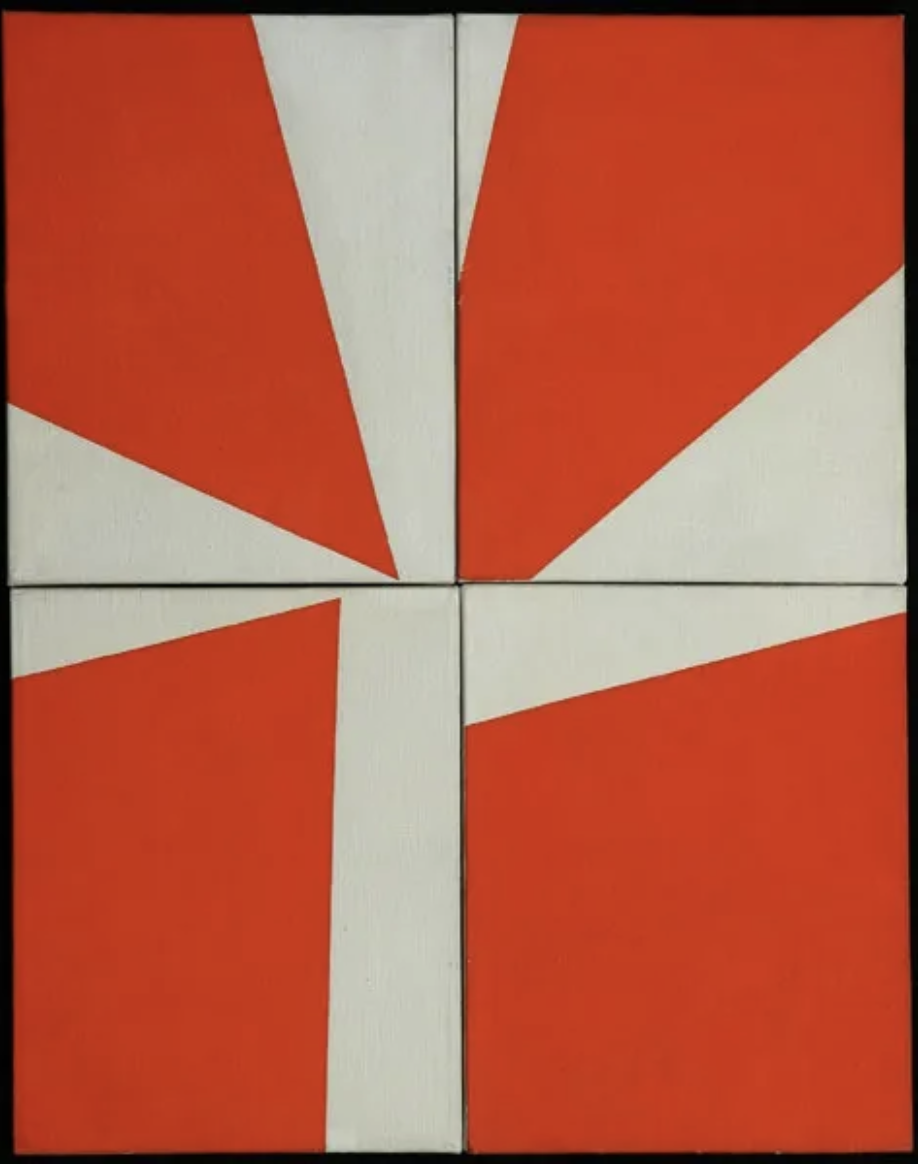
Ralph Coburn, “Cross,” 1950, oil on four canvas panels, each panel 10”x8”, 20”x16” overall, David Hall LLC
I never met Ralph Coburn, but I live about four houses away from his studio; many of my neighbors knew him. Lead by their reports, every single summer I think of a universally annointed “sweet man” swimming the breadth of Folly Cove each day wearing his straw bowler. Even the greatest of artists will be remembered by their neighbors for their most human ways. Here is my essay on Ralph Coburn, which is also the voice over for my Color of Light video on him. The link to that is at the bottom of the page.
In the northwest corner of Gloucester, a shingled cottage perches on Washington Street facing Folly Cove, a modest structure that many people know as the place where the Folly Cove Designers once printed their textiles. Yet the next resident of this unassuming home would quietly advance some of the most provocative artistic concepts of his time.
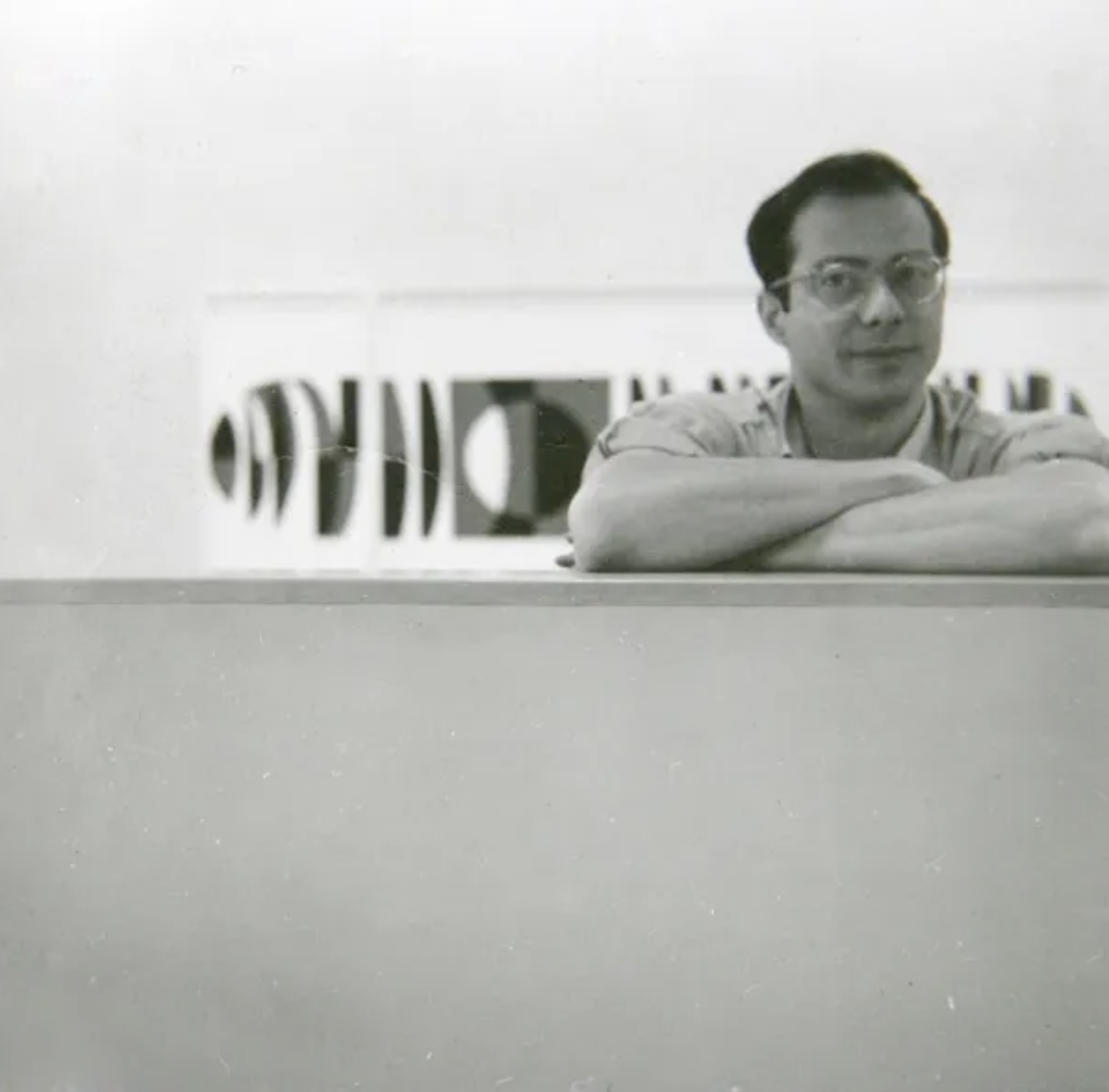
Ralph Coburn at the Boris Mirski Gallery c. 1950
From 1975 until his death in 2018, the cottage served as the summer home and studio of Ralph Coburn, an artist who moved softly among giants and created a temporal body of work with ground‑breaking vision.
The Boston Globe art critic Sebastian Smee observed in 2010 that “not enough people know about Coburn’s work, which is spare, beautiful, witty, and uncannily satisfying,” noting too that Coburn himself was “modest to a fault,” a quality that may help explain his relative obscurity. Born in 1923, Coburn grew up in Miami, Florida, and initially studied architecture at MIT before the Second World War interrupted his studies. Disqualified from the Army because of vision problems, he returned to Florida and worked as a draftsman in the Miami Air Force, translating three‑dimensional airplane parts into two dimensions.

This early experience—MIT’s culture of invention and the discipline of drafting airplane parts in flat, schematic form—would later distinguish Coburn from his peers who had attended traditional art schools. He sometimes felt inadequate about his drawing skills and his lack of conventional art training, yet those same years at MIT and at the drafting table quietly prepared him for the novel direction his work would ultimately take. His visual language was that of blueprints, flat forms, and finished technical drawings rather than landscapes and figure studies, and this inheritance would shape both his resistance to prevailing trends and his embrace of a radically two‑dimensional pictorial space.
After the war Coburn returned to Boston, this time to study painting formally and to work at the Boris Mirski Gallery, whose owner was determined to cultivate an avant‑garde in Boston. In Boston Coburn reconnected with a group of friends he had first met before the war, many of them students at the School of the Museum of Fine Arts. One of these, Barbara Swan, introduced Coburn and their circle to Cape Ann, likely in 1947 when she rented a summer studio on Bearskin Neck in Rockport, where her family had deep roots. But it was Coburn’s friendship with Ellsworth Kelly that would prove most decisive, a bond that united two young artists who would turn away, together, from the dominant language of Abstract Expressionism.
Coburn and Kelly were younger than Franz Kline, Jackson Pollock, and Willem de Kooning, whose gestural abstractions ruled the American scene, and they found the swooshes and drips of this expressive mode unappealing. In 1949 Kelly invited Coburn to France, and the two Boston artists went to Europe in search of a different lineage of modernism. They gravitated toward the ntellectualism of artists such as Matisse, Paul Klee, and Picasso, whose work offered a more structural path away from representation. As Pollock spattered paint in New York, artists across Europe were responding to Surrealism and Dadaism, embracing concepts rather than still lifes as their subjects. In Paris, John Cage composed music by the flip of a coin, using chance to determine pitch and notes, while his partner, the dancer Merce Cunningham, applied related ideas of time and space to the ballet bar.
Immersed in this environment, Coburn and Kelly began to reduce the elements in their paintings to their most minimal form, stripping away layers of metaphor, narrative, or symbolism. Color became simply color, and shape simply shape; painting, for both of them, took on an almost architectural logic. For Coburn, this embrace of two dimensions came naturally, grounded in his training in blueprints and flat forms and unburdened by an academic art education, as Kelly had been. The page or canvas, for Coburn, was never a window onto the world so much as a plane on which to arrange and test relationships.
When Kelly began to experiment with chance in his work, Coburn posed a characteristic question: “Well, this has been done—what can I do that is original?” Drawing on the MIT ethos of invention over imitation, he turned away from chance and toward something he called “choice.” In the early 1950s he created a series of works labeled “Arranged by Choice,” each composed of separate canvases contained within a rectangle and capable of being rearranged in almost infinite combinations. The person hanging the work was invited to determine the order and placement of the panels, thus participating directly in the creation of the piece. In this way each painting came with an embedded invitation to partner with the artist. Coburn described this principle as “participatory.”
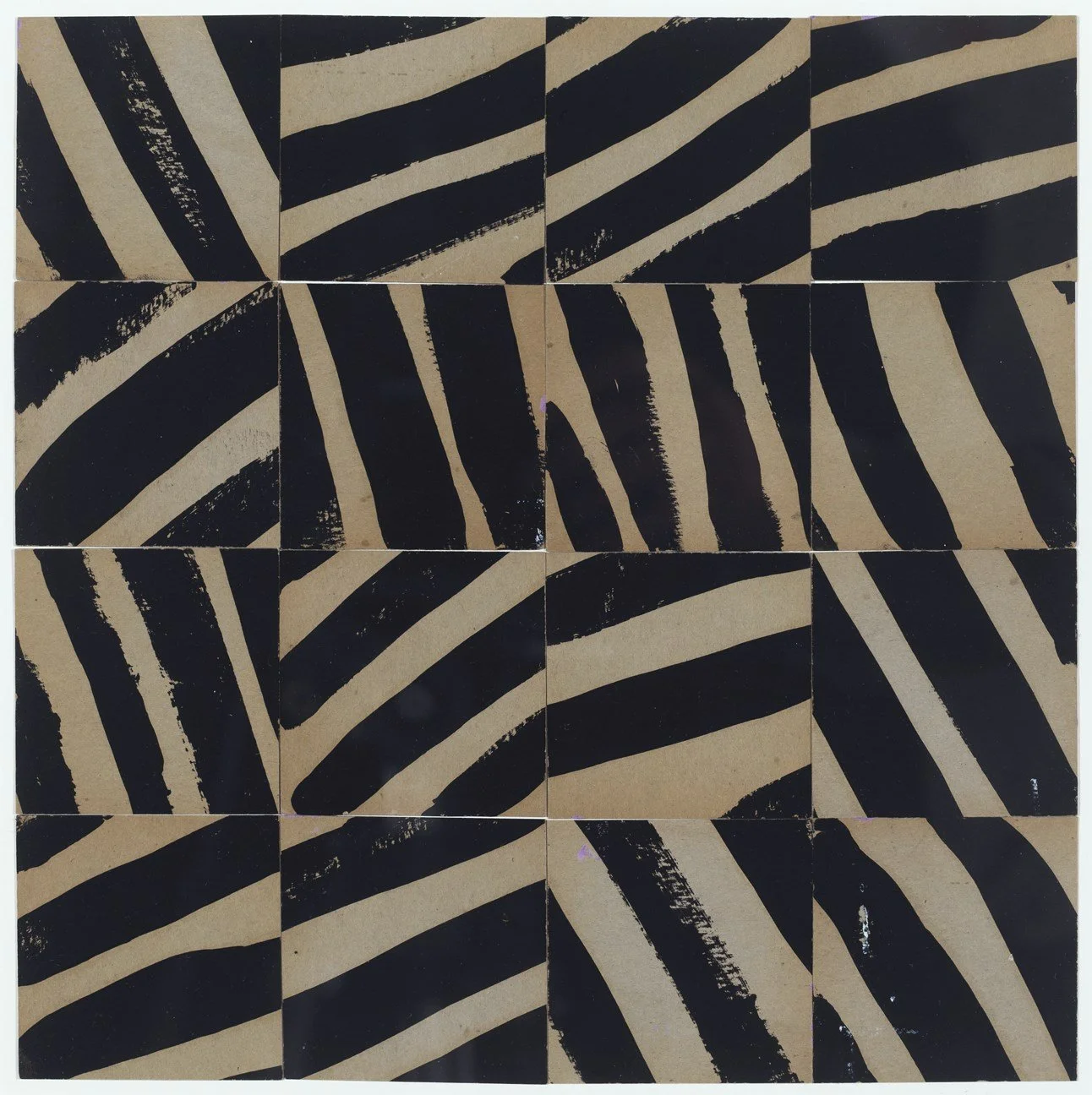
Arranged by Choice Composition c. 1951, ink on sixteen, 3”x3” panels 12”x12” overall, David Hall Gallery LLC
From these works he took a further step and broke apart the containing rectangle itself. Instead of a fixed configuration of panels bounded by a single frame, Coburn developed pieces consisting of multiple panels intended to be distributed across a wall as the collaborator chose. In these works the relationship between painting and wall changed suddenly and radically: the painting became an active component of the surrounding environment rather than a static object translating some bit of elsewhere onto the wall. The person installing the work once again participated in each new composition, so that meaning and form emerged from an interaction between artist, object, and site.
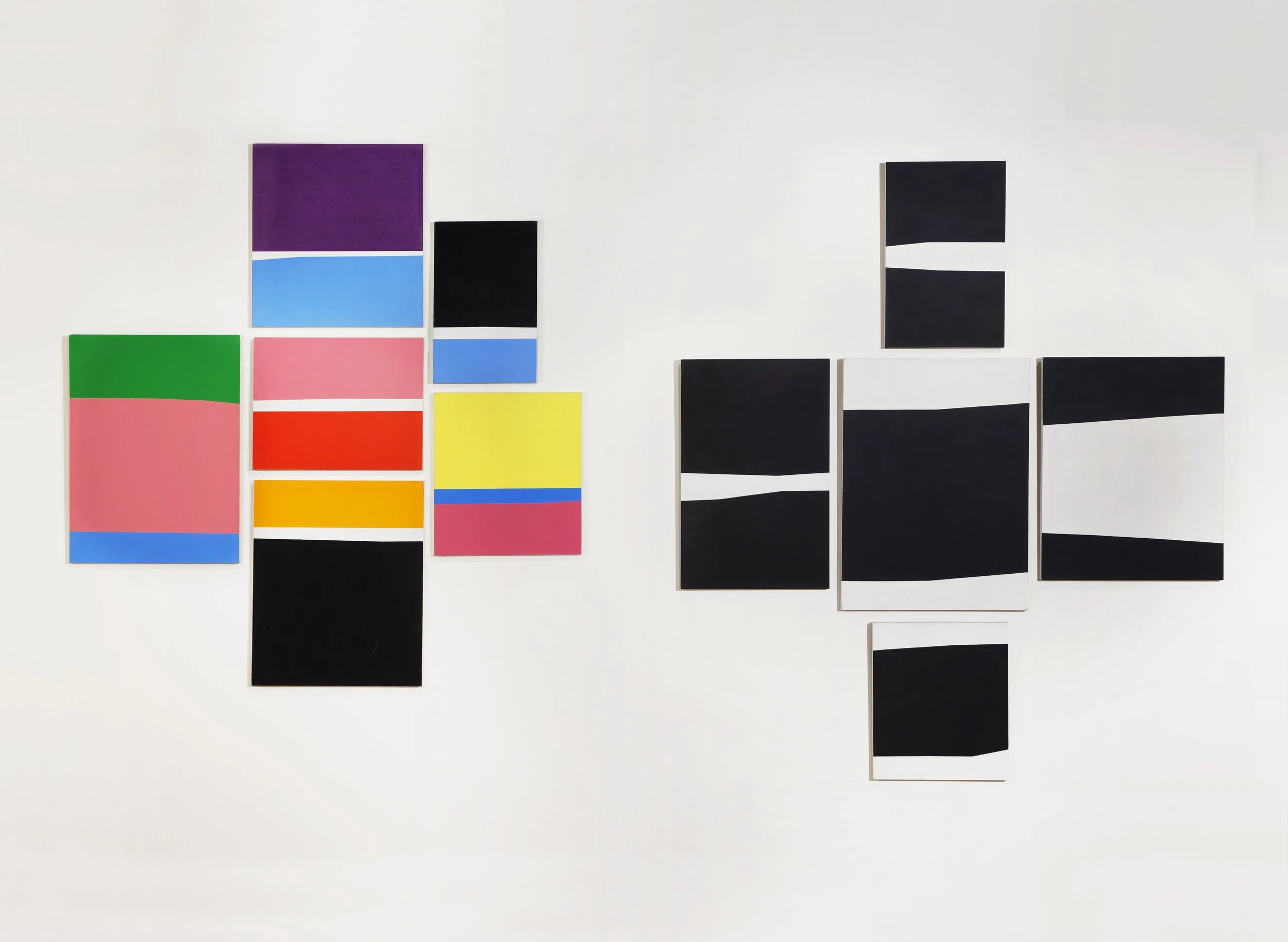
“Random Sequence” works on exhibit at the Arts Club of Chicago in 2017, oil on canvas
Later, Coburn shifted beyond these explicitly participatory pieces and began to elevate the grid itself as an independent concept.
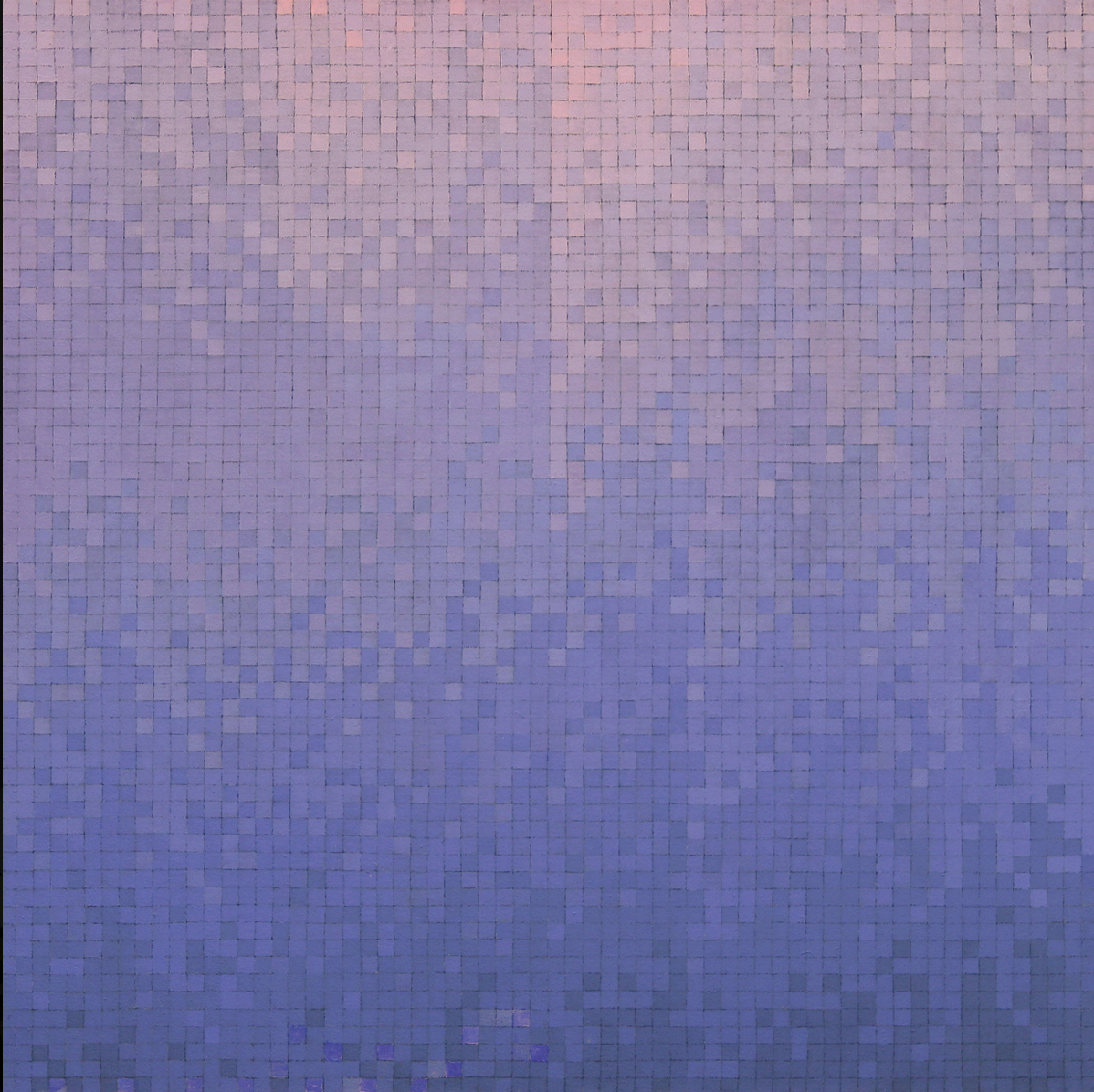
Evening Painting, 1988, acrylic on canvas, 32”x32”, David Hall LLC
Coburn’s modesty may also have obscured another of his contributions, one rooted not in painting but in graphic design. In 1957 he left France and returned to Boston to work as a layout artist and typographer in MIT’s Office of Publications, designing posters and graphics in a setting that bridged institutional communication and modernist experimentation. Within this design studio he has recently been credited with guiding the team toward the Swiss Design he had seen in Europe, including almost single‑handedly importing the Helvetica font into the studio’s visual vocabulary.

The Coburn concepts - Choice, Participation and what he called Random Sequence - created by him in the 1950’s, had not been seen before. Coburn conceptualized mutability and interactivity, pioneering what became ruling themes in art in the late 20th century.
The scholarship on Coburn is only now beginning to catch up, confirming Smee’s sense that his shy, deferential nature contributed to the under‑recognition of his achievement. Today his work hangs in the Rose Art Museum at Brandeis, and the Museum of Fine Arts, Boston. In 2012 the Cape Ann Museum organized an exhibition of his work titled Arranged by Choice. Five years later, at the age of 94, he received his first national exhibition, Ralph Coburn, Random Sequence, at the Art Club of Chicago.
And this element of Coburn’s life cannot be discounted: the fact that even art critics note his humility, graciousness and kindness. Perhaps there was artistic power in that kindness. The way architecture and drafting informed Coburn’s work, perhaps the nature of his personality informed it, too, particularly in his Participatory pieces.
“Come, let’s do this together,” Coburn said, building inclusiveness and generosity into every painting.
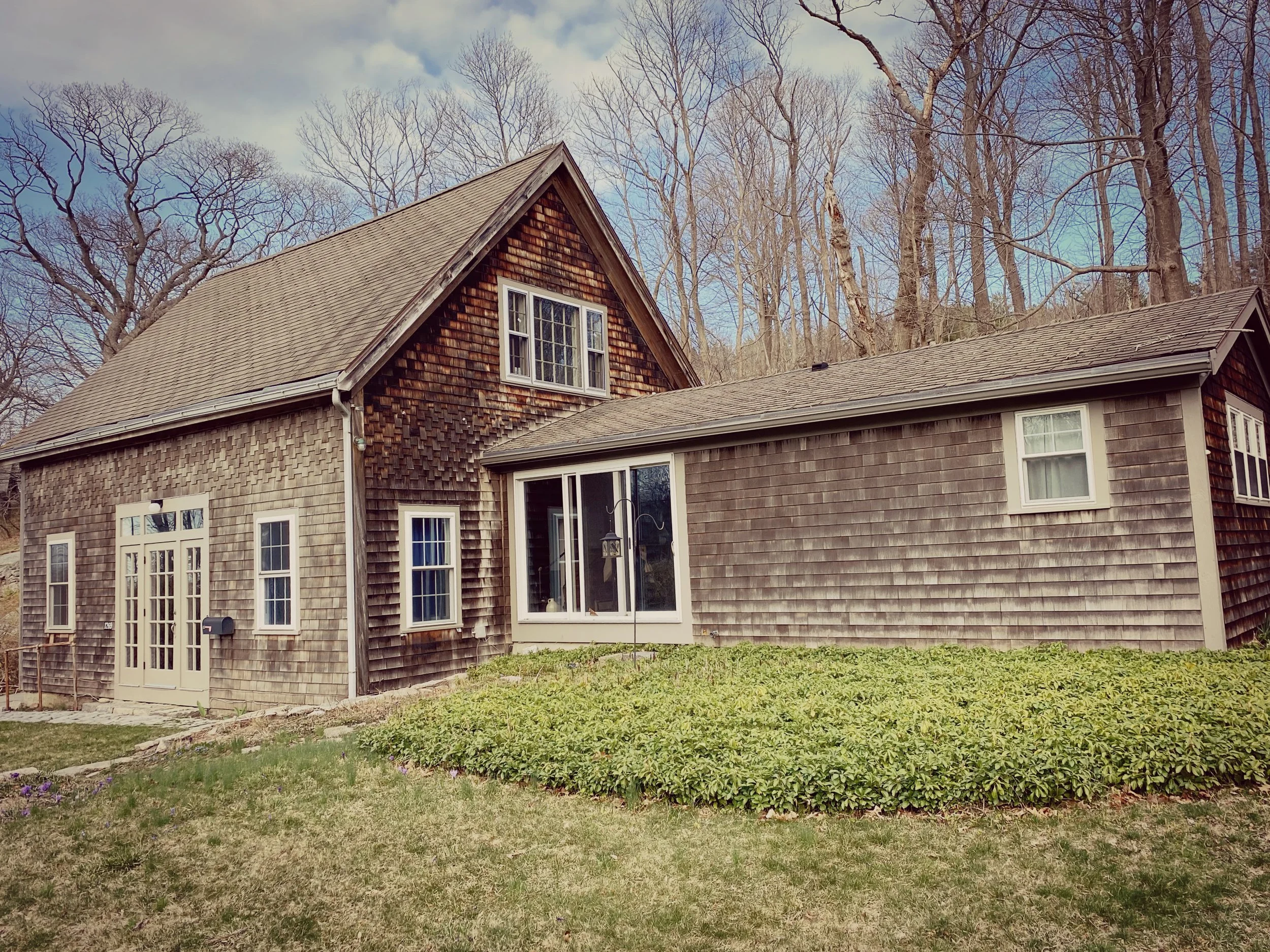
Still standing by the road in Folly Cove is the little studio, as modest a building as Coburn was an artist, but where he imagined, invented, and created, his feet on Folly Cove floorboards and his mind full of ideas born in a Paris friendship.
To watch my Color of Light video on Ralph Coburn (which includes footage of a wonderful interview done with him the Blanton Museum of Art at the University of Texas Austin not long before he passed in 2018) head here.